
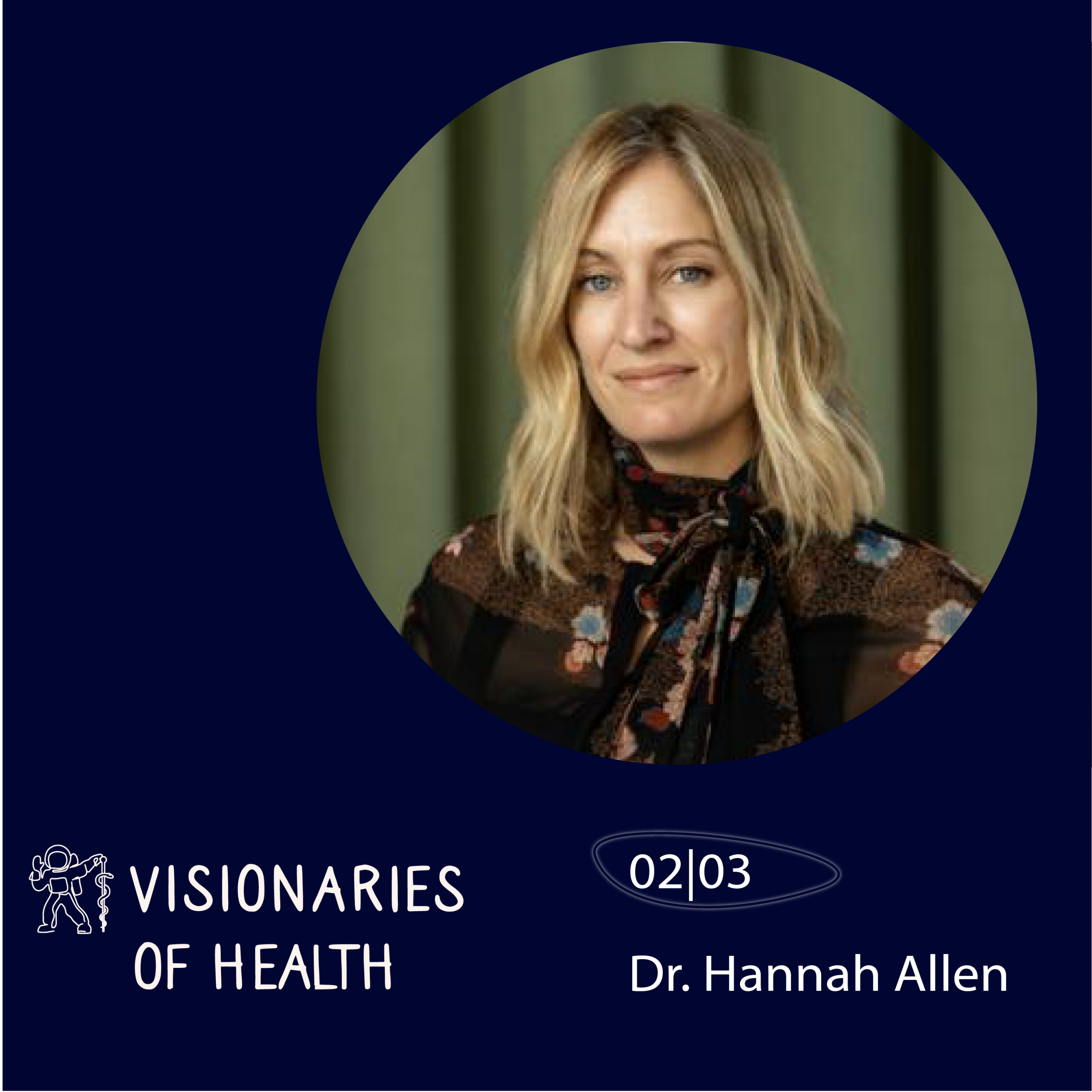
Dr. Hannah Allen on AI in Healthcare: How Heidi Health Is Transforming Clinical Documentation and Giving Doctors Time Back
In this English-language episode of the podcast Visionäre der Gesundheit, Inga Bergen speaks with Dr. Hannah Allen, Chief Medical Officer UK & EU at Heidi Health. A former NHS general practitioner and digital health leader, Dr. Hannah Allen offers deep insights into how artificial intelligence is reshaping healthcare delivery and how ambient AI is already changing everyday clinical workflows.
At the heart of the conversation is a central question: how can technology support clinicians without removing the human connection from medicine?
Who is Dr. Hannah Allen?
Dr. Hannah Allen is a physician, entrepreneur, and one of the leading voices in digital health innovation. She began her medical career in the UK’s National Health Service (NHS), working as a general practitioner and GP trainer.
Early in her clinical practice, Dr. Hannah Allen experienced first-hand the growing pressure in healthcare systems: rising administrative burdens, limited consultation time, and increasing complexity in patient care. These challenges shaped her perspective on where healthcare was heading.
Motivated by the desire to improve clinical efficiency, Dr. Hannah Allen moved into digital health in 2015. She joined Babylon Health, one of the early pioneers in AI-powered triage and virtual care. There, she led multiple product initiatives, including work in women’s health.
Today, Dr. Hannah Allen is Chief Medical Officer at Heidi Health, where she focuses on building AI tools designed to reduce administrative workload and allow clinicians to focus more on patients.
The turning point: Why Dr. Hannah Allen joined Heidi Health
Despite her extensive experience in digital health, Dr. Hannah Allen was initially cautious about new AI startups. That changed after a colleague encouraged her to test Heidi Health in a real-world setting.
She used the system in her everyday environment—surrounded by typical distractions—yet the AI still produced an accurate and structured clinical transcription.
For Dr. Hannah Allen, this was a defining moment. The technology was not just conceptually impressive; it worked under realistic clinical conditions.
Equally important was the fact that many members of the Heidi Health founding team come from clinical backgrounds. This ensured the product was built around real-world healthcare workflows rather than abstract technical assumptions.
The core problem in healthcare: Not enough time for patients
Throughout the conversation, Dr. Hannah Allen highlights a structural issue in modern healthcare systems: clinicians spend too much time on documentation and administrative tasks instead of patient care.
Doctors are frequently interrupted by calls, system navigation, paperwork, and non-clinical tasks. As a result, the quality of the doctor–patient interaction often suffers.
This is where ambient AI comes in. The technology listens during consultations, automatically generates structured documentation, and significantly reduces post-visit administrative work.
For Dr. Hannah Allen, this represents the biggest opportunity of AI in healthcare: not replacing clinicians, but restoring time for human care.
Impact in the NHS: Real-world results
A key part of the discussion focuses on measurable outcomes from the UK healthcare system.
Dr. Hannah Allen explains that Heidi Health has seen rapid adoption across the NHS, with significant real-world impact:
- Millions of patient consultations transcribed
- Millions of clinical hours saved
- Significant reduction in post-consultation documentation workload
- Major decrease in overall administrative burden
- Noticeable improvements in clinician well-being
Many healthcare professionals also report reduced burnout, fewer late working hours, and improved work-life balance.
Dr. Hannah Allen emphasizes that these changes are not theoretical—they directly affect daily clinical practice.
From AI scribe to intelligent care partner
Another major theme in the conversation is the future evolution of Heidi Health.
For Dr. Hannah Allen, automated documentation is only the starting point. The long-term vision is far more ambitious: an intelligent AI assistant that supports clinicians across the entire care journey.
This includes:
- Summarizing patient histories and records
- Supporting diagnostic reasoning and clinical review
- Preparing referrals and clinical documentation
- Automating administrative workflows
- Connecting and structuring medical information across systems
The ultimate goal is to create a “care partner” that functions like an additional clinical assistant, helping manage routine tasks so clinicians can focus on complex decision-making and patient interaction.
Why clinical expertise is essential in healthcare AI
Dr. Hannah Allen repeatedly stresses that successful healthcare AI must be built with clinicians, not just engineers.
Healthcare systems differ significantly across countries, hospitals, and workflows. Without clinical input, AI tools risk becoming technically impressive but practically unusable.
At Heidi Health, product development is deeply grounded in clinical reality. Teams study real consultation workflows and adapt the system accordingly.
For Dr. Hannah Allen, one metric matters most: adoption. If clinicians do not consistently choose to use the tool, it cannot create meaningful impact.
A critical question: Will AI reduce clinical skills?
The conversation also addresses a common concern: could AI lead to a decline in clinical skills over time?
Dr. Hannah Allen acknowledges this concern but places it in historical context. Every major technological shift in medicine—from the stethoscope to modern imaging—has raised similar questions.
At the same time, she argues that healthcare systems are already under too much pressure to rely on traditional approaches alone. Increased staffing alone will not solve structural inefficiencies.
The key, she explains, is ensuring that clinicians remain in control and are properly supported in adopting new tools.
Safety, responsibility, and transparency
A particularly important part of the discussion focuses on safety and accountability.
Dr. Hannah Allen explains that at Heidi Health, human oversight remains central. No clinical note is automatically entered into a patient record without review and approval by a healthcare professional.
In addition, the platform uses multiple safety mechanisms:
- Continuous quality monitoring
- Regular system audits
- Close collaboration with NHS partners
- Systematic error tracking and analysis
- Built-in validation checks
Dr. Hannah Allen emphasizes that transparency and trust are essential for the adoption of AI in healthcare.
Benefits for patients
The impact of ambient AI is not limited to clinicians—patients also benefit directly.
Dr. Hannah Allen explains that patients increasingly receive clear, structured summaries of their consultations. Instead of complex medical jargon, they get understandable explanations of their condition and treatment plan.
This helps patients:
- Understand diagnoses more clearly
- Follow treatment plans more easily
- Feel more involved in decision-making
As a result, communication improves, and patient engagement often increases as well.
Dr. Hannah Allen’s vision for the future of medicine
Towards the end of the conversation, Dr. Hannah Allen outlines her vision for healthcare in the coming five years.
She imagines a system where clinicians spend significantly more time with patients and far less time interacting with administrative systems. Voice becomes the primary interface, while AI handles documentation and data processing in the background.
Patients will no longer need to repeatedly explain their medical history, as relevant information will be intelligently surfaced when needed. At the same time, better use of data will enable earlier detection of diseases and more personalized care.
Despite these advances, Dr. Hannah Allen is clear: the future of medicine remains fundamentally human.
Final thoughts: Why this episode is worth listening to
This episode featuring Dr. Hannah Allen stands out because it connects real clinical experience with practical AI implementation in healthcare.
Rather than discussing abstract ideas, she shares concrete evidence from the NHS and explains how AI is already changing clinical workflows today. At the same time, she openly addresses risks, limitations, and ethical considerations.
Anyone interested in how AI is reshaping healthcare delivery—and the role Heidi Health plays in that transformation—will find this episode highly relevant. Dr. Hannah Allen brings together clinical expertise, product thinking, and strategic vision in a way that makes the future of healthcare both understandable and tangible.
Leave a Reply